

Van der Waals Forces
Van der Waals forces are the weak attractions between molecules (not the strong bonds within them). They include London dispersion forces and permanent dipole–dipole forces, and they explain why covalent substances melt, boil and stick together at all.
"Van der Waals" is often used as an umbrella term for all intermolecular forces except hydrogen bonding; the always-present type is the London (dispersion) force.
The types, weakest to strongest
London (dispersion) forces — present in every molecule. Electrons move constantly, creating a fleeting instantaneous dipole that induces a dipole in a neighbour; the two attract. They get stronger with more electrons (bigger molecules).
Permanent dipole–dipole forces — extra attraction between molecules that have a permanent dipole (a polar molecule such as HCl), δ⁺ of one lining up with δ⁻ of the next.
Hydrogen bonding — the strongest intermolecular force, when H is bonded to N, O or F. Often treated as a special, separate case rather than a "van der Waals" force.
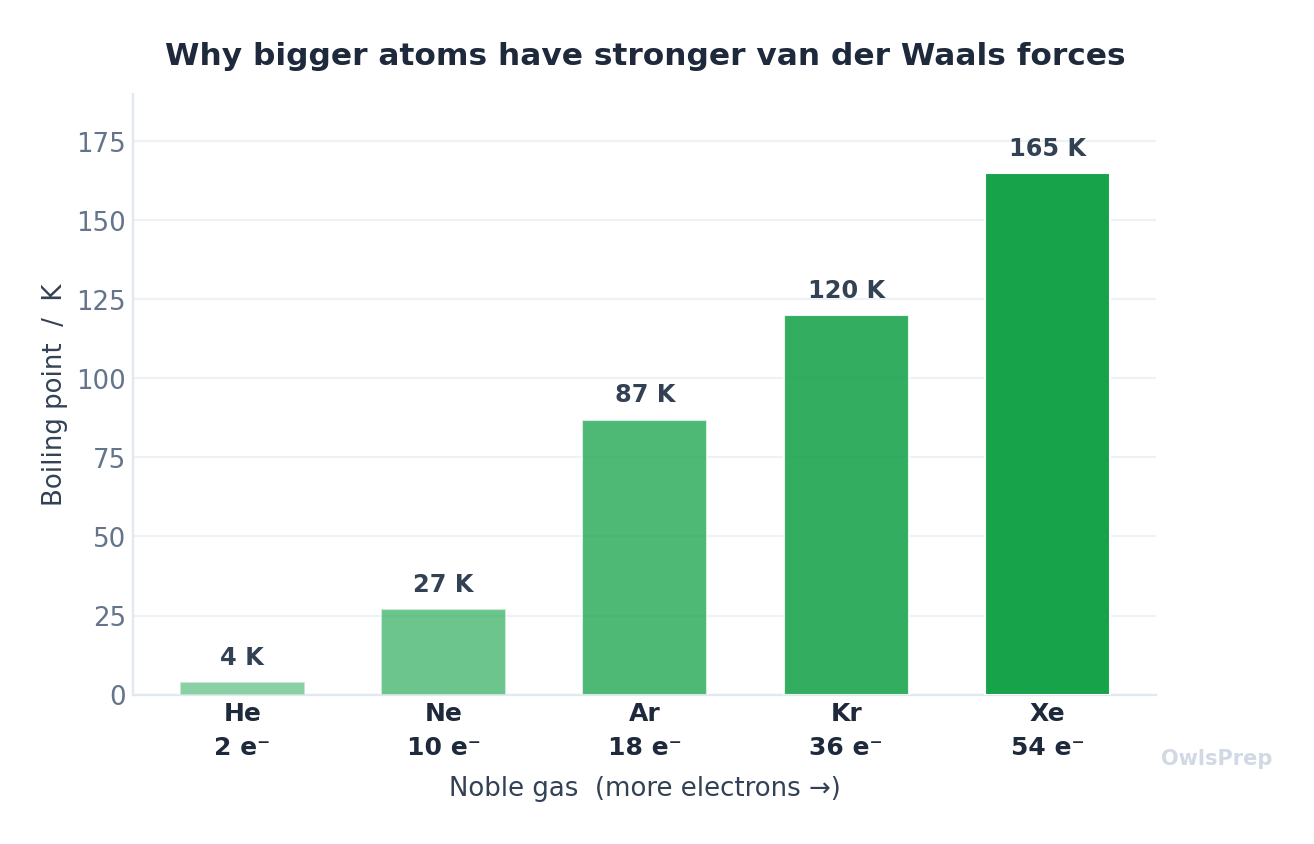
Bigger atoms → stronger London forces. Down the noble gases, the number of electrons rises (He 2 → Xe 54). More electrons make larger, more easily distorted electron clouds, so the instantaneous dipoles — and the forces between them — are stronger. That's why the boiling point climbs steeply from 4 K (He) to 165 K (Xe), even though these atoms have no permanent dipole at all.
more electrons (higher molar mass) and a larger surface area of contact — long straight-chain molecules pack closer and attract more than branched ones of the same formula.
Worked example — explain a boiling-point trend
The boiling points of the halogens rise from F₂ (−188 °C) to I₂ (+184 °C). Explain this in terms of intermolecular forces.
All four halogens are non-polar diatomic molecules, so the only intermolecular forces are London (dispersion) forces.
Going down the group, each molecule has more electrons (F₂ has 18, I₂ has 106).
More electrons give larger, more polarisable electron clouds, so the instantaneous/induced dipoles are stronger — the London forces increase.
Stronger forces need more energy to overcome, so more energy (a higher temperature) is required to boil the substance.
Boiling point rises F₂ → I₂ because London forces strengthen as the number of electrons increases.
Common mistakes
Saying you "break covalent bonds" when a molecular substance boils — boiling only overcomes the intermolecular forces; the covalent bonds inside each molecule stay intact.
Claiming non-polar molecules have no intermolecular forces — every molecule has London forces, even noble gases.
Assuming a heavier molecule always boils higher — compare the dominant force: a small molecule with hydrogen bonding (e.g. water) can beat a larger one with only London forces.
Frequently asked questions
What are van der Waals forces in simple terms?
They are weak attractions between whole molecules, caused by uneven distributions of electrons. The most common is the London (dispersion) force: electrons momentarily bunch up on one side of a molecule, creating a tiny temporary dipole that pulls on the next molecule. They are much weaker than covalent or ionic bonds.
Are van der Waals forces the same as London dispersion forces?
London dispersion forces are one type of van der Waals force — the type present in every molecule. "Van der Waals" is the broader term that also includes permanent dipole–dipole attractions. Hydrogen bonding is usually treated separately as a stronger, special case.
Why do larger molecules have stronger van der Waals forces?
Larger molecules have more electrons and bigger electron clouds that are more easily distorted (more polarisable). This makes the instantaneous and induced dipoles larger, so the attraction between molecules is stronger — which is why boiling points rise as molecules get bigger.
This concept in your exam
Open your board's guide for exam-specific technique and past-paper practice:
Snap a photo and get the full working — step by step, checked against the mark scheme — not just the final answer.
Solve a question free →