

Ionization Energy Trends
First ionization energy is the energy needed to remove one mole of electrons from one mole of gaseous atoms to form one mole of gaseous +1 ions. Across the periodic table it follows two clear trends: it increases across a period and decreases down a group.
Also spelled ionisation energy (UK). Symbol · units kJ mol⁻¹.
The two trends at a glance
Across a period → increases
Nuclear charge rises while electrons fill the same outer shell, so shielding stays almost constant. Stronger attraction and a smaller radius mean it is harder to remove an electron.
Down a group → decreases
Each element adds an inner shell, so radius and shielding both grow. These outweigh the rising nuclear charge, so the outer electron is easier to remove.
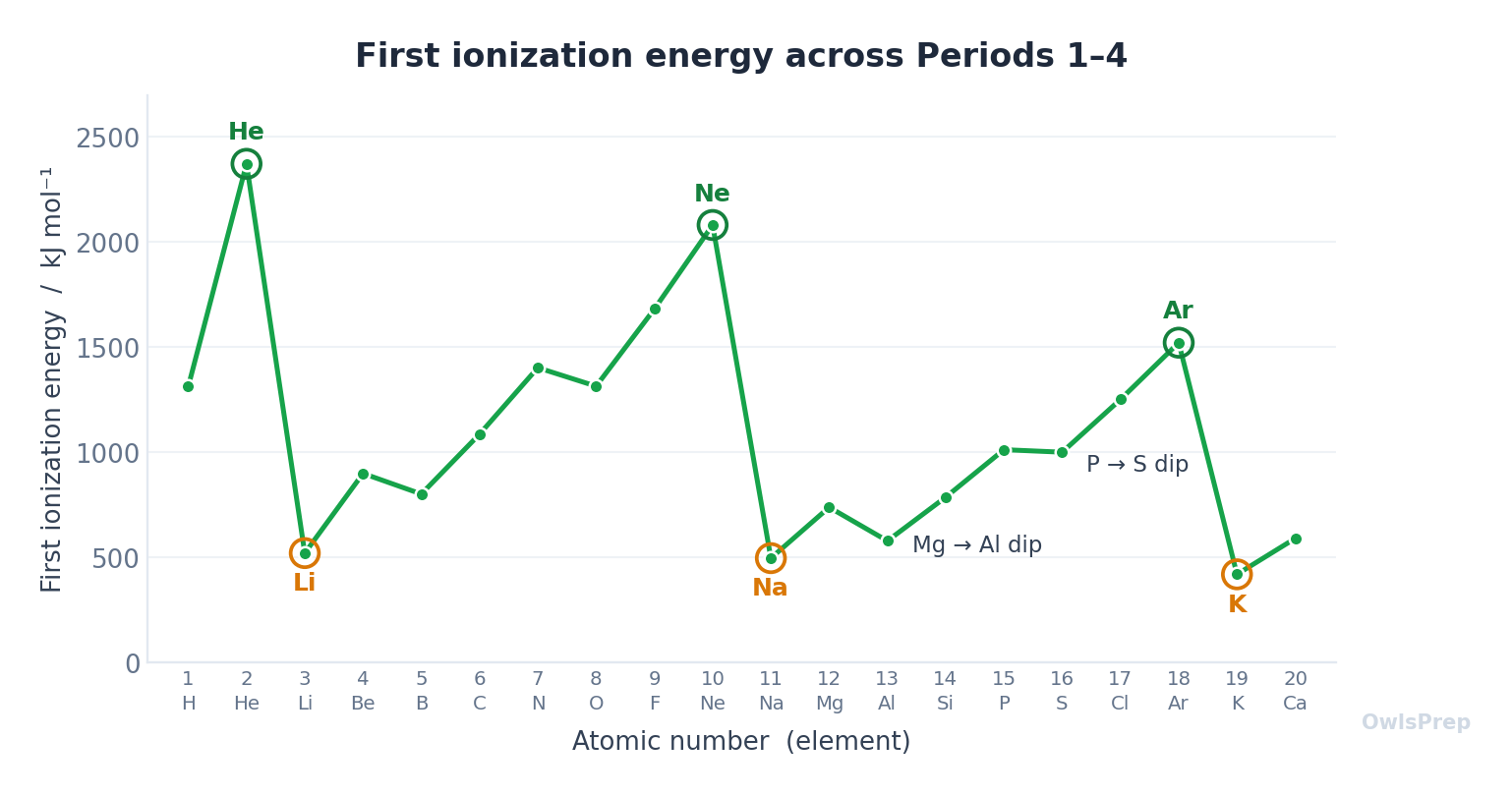
Reading the graph: ionization energy peaks at the noble gases (He, Ne, Ar — stable full shells) and troughs at the alkali metals (Li, Na, K — one easily-lost outer electron). Each period repeats the pattern, and two small dips break the upward run — explained below.
Why the trend happens — the four factors
Nuclear charge — more protons pull the outer electrons in harder, raising ionization energy.
Atomic radius — a larger nucleus–electron distance weakens the pull, lowering ionization energy.
Shielding — inner electrons repel the outer electron, reducing the net nuclear pull.
Sub-shell stability — full or half-full sub-shells are extra stable, raising ionization energy.
The two exceptions (the dips)
Across Period 3 the trend isn't perfectly smooth — it dips at two points, and examiners love asking why:
aluminium's outer electron sits in a higher-energy 3p sub-shell (slightly shielded by the full 3s), so it is easier to remove than magnesium's 3s electron.
in sulfur, one 3p orbital now holds a paired electron. The electron–electron repulsion in that pair makes it easier to remove, so S has a lower value than P.
Worked example
Explain why the first ionization energy of chlorine is higher than that of sulfur.
Both elements are in Period 3, so their outer electrons are in the shell — shielding is essentially identical for both.
Chlorine has one more proton than sulfur, so its nuclear charge is greater.
A greater nuclear charge means a stronger attraction between the nucleus and the outer electrons.
More energy is therefore needed to remove an electron, so chlorine's first ionization energy is higher.
— chlorine has a higher nuclear charge with the same shielding.
Successive ionization energies → find the group
Removing electrons one after another gives successive ionization energies. A large proportional jump means the next electron is coming from a new, inner shell — which tells you how many outer electrons the atom has, and hence its group.
The successive ionization energies (kJ mol⁻¹) of an element are 738, 1451, 7733, 10540, 13630. Deduce its group.
Find the biggest proportional jump: 1451 → 7733 is a ~5× increase, far larger than any other step.
That jump means the 3rd electron comes from an inner shell closer to the nucleus.
So there are 2 outer electrons ⇒ the element is in Group 2.
Group 2 — two electrons removed easily, then a big jump.
always compare proportional change, not absolute change. A jump from 1500 → 7700 (5×) matters; 10500 → 13600 (only 30%) does not.
Common mistakes
Quoting the definition without "gaseous" or "+1 ions" — both are needed for the mark.
Explaining a period trend with "atoms get bigger" — across a period the radius decreases; use nuclear charge + shielding instead.
Frequently asked questions
Why does ionization energy decrease down a group?
Going down a group, each element gains an extra electron shell. The outer electron is further from the nucleus and better shielded by inner electrons, so despite the higher nuclear charge the net attraction is weaker — less energy is needed to remove it.
Why is there a dip at oxygen (and sulfur)?
In Group 16 the outer p sub-shell reaches p⁴, so one p orbital contains a paired electron. Repulsion between that pair makes the electron easier to remove, giving a value slightly below the Group 15 element next to it.
What's the difference between first and successive ionization energy?
The first ionization energy removes one electron from a neutral gaseous atom. Successive ionization energies remove the 2nd, 3rd, 4th… electrons in turn — each is larger than the last because you are pulling an electron from an increasingly positive ion.
This concept in your exam
Open your board's guide for exam-specific technique and past-paper practice:
Snap a photo and get the full working — step by step, checked against the mark scheme — not just the final answer.
Solve a question free →