

Electronegativity
Electronegativity is the ability of an atom to attract the shared pair of electrons in a covalent bond towards itself. The higher an atom's electronegativity, the more strongly it pulls the bonding electrons — so it decides whether a bond is non-polar, polar, or ionic.
Measured on the Pauling scale (fluorine = 3.98, the highest) — symbol χ (chi).
The two periodic trends
Across a period → increases
Nuclear charge rises while the bonding electrons stay in the same shell (shielding roughly constant) and the atom gets smaller. The nucleus grips the bonding pair more tightly, so electronegativity increases.
Down a group → decreases
Each element adds an inner shell, so the bonding pair is further from the nucleus and better shielded. The pull on it weakens, so electronegativity decreases.
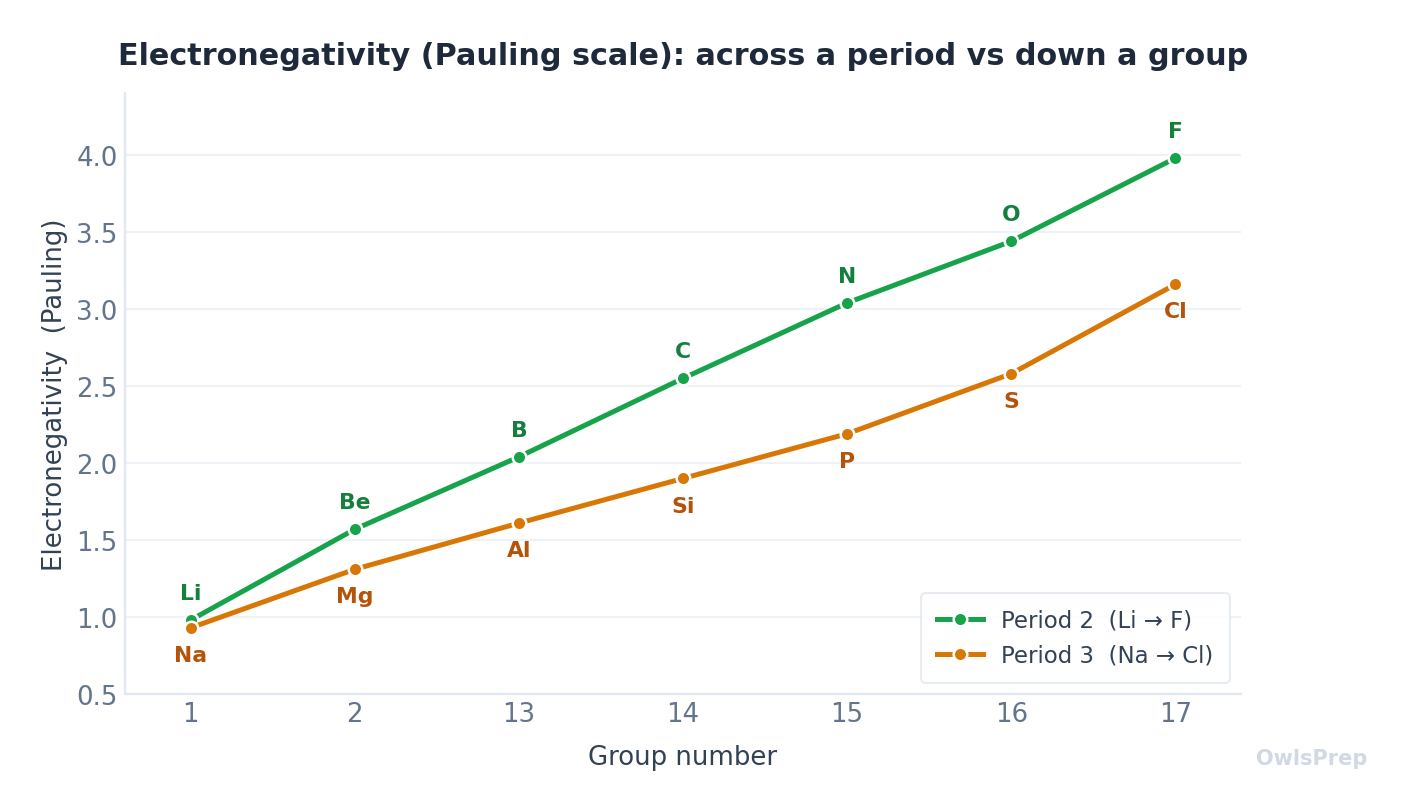
Reading the graph: both lines rise left-to-right — electronegativity increases across a period. The Period 2 line sits above Period 3 at every group — electronegativity decreases down a group. Fluorine, top-right, is the most electronegative element; the noble gases are left off because they rarely bond.
Electronegativity difference decides the bond type
Compare the two atoms' electronegativities (Δχ). The bigger the gap, the more unevenly the electrons are shared:
non-polar covalent — electrons shared evenly (e.g. Cl–Cl, C–H).
polar covalent — the more electronegative atom gains a partial negative charge δ⁻ (e.g. H–Cl, O–H).
ionic — one atom pulls the electrons off entirely (e.g. Na⁺Cl⁻).
Worked example — predict bond polarity
Using electronegativities H = 2.20, N = 3.04, decide whether the N–H bond in ammonia is polar, and which atom is δ⁻.
Find the difference: Δχ = 3.04 − 2.20 = 0.84.
A difference of ~0.8 is moderate — too big for non-polar, too small for ionic — so the bond is polar covalent.
The more electronegative atom holds the shared electrons more closely, giving it the partial negative charge.
Nitrogen is more electronegative than hydrogen, so N is δ⁻ and each H is δ⁺.
The N–H bond is polar, with N as δ⁻ and H as δ⁺.
Common mistakes
Confusing electronegativity with electron affinity — electronegativity is about attracting a shared pair in a bond; electron affinity is the energy change when a free atom gains an electron.
Saying electronegativity increases down a group because "more protons" — the extra shell and shielding win, so it decreases down a group.
Quoting a value for a noble gas — He, Ne and Ar are usually left off the scale because they don't normally form bonds.
Frequently asked questions
What is the most electronegative element?
Fluorine, with a Pauling value of 3.98 — the top-right of the periodic table (excluding the noble gases). Electronegativity increases towards fluorine because that corner combines a high effective nuclear charge with the smallest atoms, so the nucleus grips the bonding electrons most tightly.
Why does electronegativity decrease down a group?
Going down a group, each atom gains an extra electron shell, so the bonding electrons are further from the nucleus and shielded by more inner electrons. Even though nuclear charge rises, the greater distance and shielding weaken the pull, so electronegativity falls.
What is the difference between electronegativity and electron affinity?
Electronegativity describes how strongly a bonded atom attracts the shared pair of electrons in a covalent bond — it's a relative, unitless scale. Electron affinity is the actual energy change (in kJ mol⁻¹) when an isolated gaseous atom gains one electron. They're related but not the same.
This concept in your exam
Open your board's guide for exam-specific technique and past-paper practice:
Snap a photo and get the full working — step by step, checked against the mark scheme — not just the final answer.
Solve a question free →