

Electron Configuration
Electron configuration is the way an atom's electrons are arranged across its shells, sub-shells and orbitals. You build it up by filling the lowest-energy orbitals first, so the configuration of an atom tells you how its electrons are organised and how the atom will bond.
Written as 1s² 2s² 2p⁶… — the number is the shell, the letter is the sub-shell, and the superscript is how many electrons it holds.
The three rules that build every configuration
Aufbau principle — fill the lowest-energy orbitals first, working up: 1s → 2s → 2p → 3s → 3p → 4s → 3d → 4p…
Pauli exclusion principle — each orbital holds at most two electrons, and they must have opposite spins (drawn ↑↓).
Hund's rule — within a sub-shell, put one electron in each orbital before pairing any up, and keep those single electrons' spins parallel.
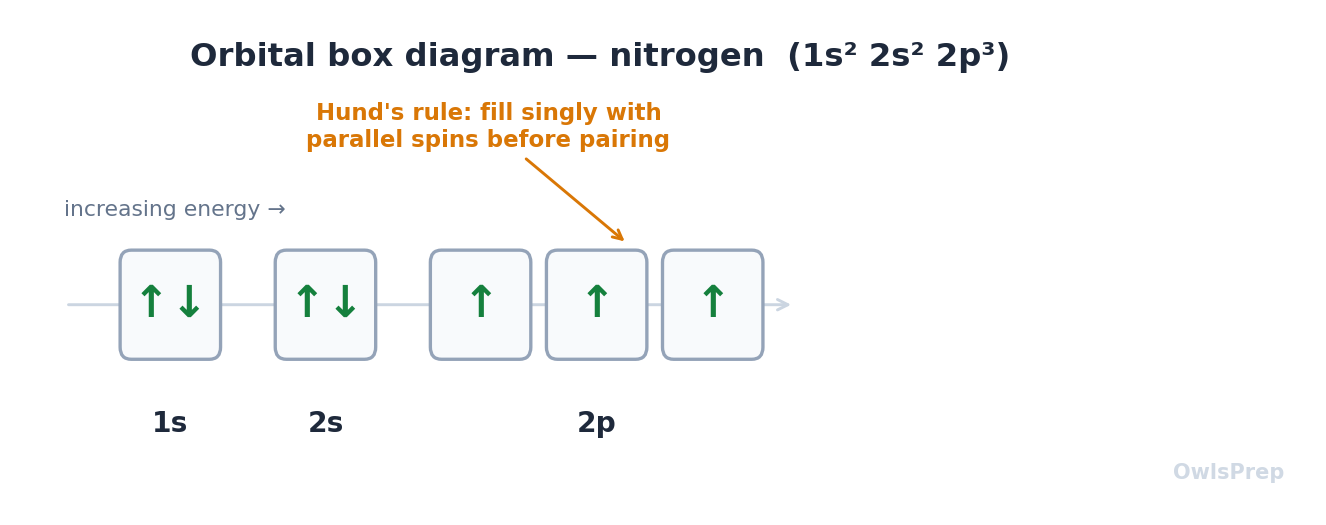
Nitrogen (1s² 2s² 2p³). The 1s and 2s orbitals are full (paired, ↑↓). The three 2p electrons spread out — one per orbital with parallel spins — because Hund's rule keeps them unpaired for as long as possible. Reading the boxes left to right follows the Aufbau filling order.
How many electrons fit in each sub-shell
Each sub-shell is made of orbitals, and every orbital holds 2 electrons. That fixes the maximum for each sub-shell:
Sub-shell | Number of orbitals | Max electrons |
|---|---|---|
s | 1 | 2 |
p | 3 | 6 |
d | 5 | 10 |
f | 7 | 14 |
The superscripts in a configuration can never exceed these values — if you write 2p⁷, something has gone wrong.
Worked example — write a full configuration
Write the full electron configuration of a sulfur atom (Z = 16).
Sulfur has 16 electrons, so we place 16 in order of increasing energy.
Fill the first two shells: 1s² (2) then 2s² 2p⁶ (8) — that accounts for 10 electrons.
Move to the third shell: 3s² uses 2 more (12 total), leaving 4 electrons for the 3p sub-shell.
Place the last 4 in 3p: 3p⁴. Check the total: 2 + 2 + 6 + 2 + 4 = 16. ✓
1s² 2s² 2p⁶ 3s² 3p⁴ — or, in shorthand, [Ne] 3s² 3p⁴.
The two exceptions examiners love: chromium and copper
A completely full or exactly half-full d sub-shell is unusually stable, so two Period-4 metals borrow an electron from 4s to reach it:
expected [Ar] 3d⁴ 4s², but actually [Ar] 3d⁵ 4s¹ — a half-full 3d⁵ is more stable than 3d⁴.
expected [Ar] 3d⁹ 4s², but actually [Ar] 3d¹⁰ 4s¹ — a full 3d¹⁰ is more stable than 3d⁹.
Ions — take electrons from 4s first
4s fills before 3d, but once 3d is occupied it drops lower in energy — so when a transition metal forms an ion, the 4s electrons leave first.
Write the electron configuration of the Fe³⁺ ion. (Iron atom: [Ar] 3d⁶ 4s².)
Start from the neutral atom: Fe is [Ar] 3d⁶ 4s².
Fe³⁺ means three electrons are removed. Remove the two 4s electrons first.
Remove one more — now from 3d — leaving 3d⁵.
That empties 4s and takes one 3d electron, giving a half-full 3d⁵.
Fe³⁺ = [Ar] 3d⁵ (the 4s electrons go before any 3d electron).
Common mistakes
Removing 3d electrons before 4s when forming ions — for transition-metal ions, 4s empties first.
Writing chromium and copper by the pattern (3d⁴4s² / 3d⁹4s²) — memorise the two exceptions 3d⁵4s¹ and 3d¹⁰4s¹.
Over-filling a sub-shell (e.g. 2p⁷ or 3d¹¹) — check each superscript against the s2 / p6 / d10 / f14 maxima.
Frequently asked questions
How do you write an electron configuration?
Count the electrons (= atomic number for a neutral atom), then fill orbitals from lowest energy up: 1s, 2s, 2p, 3s, 3p, 4s, 3d, 4p… stopping when you run out of electrons. Use a noble-gas core in brackets (like [Ne] or [Ar]) as shorthand for the inner electrons.
Why is copper 3d¹⁰4s¹ and not 3d⁹4s²?
A completely full 3d sub-shell (3d¹⁰) is more stable than 3d⁹, so copper moves one electron from 4s into 3d to reach that full sub-shell. Chromium does the same to reach a half-full, extra-stable 3d⁵ (giving 3d⁵4s¹).
What is the difference between shells, sub-shells and orbitals?
A shell is a main energy level (n = 1, 2, 3…). Each shell splits into sub-shells (s, p, d, f), and each sub-shell is made of orbitals — regions that each hold up to 2 electrons. So the 2p sub-shell has 3 orbitals and holds 6 electrons.
This concept in your exam
Open your board's guide for exam-specific technique and past-paper practice:
Snap a photo and get the full working — step by step, checked against the mark scheme — not just the final answer.
Solve a question free →